
Tub price is a lie: cost per 25g of protein
Normalize every tub to cost per 25 grams of protein before you rank value.
TLDR
Tub sticker price ranks packaging. Cost per 25g protein ranks protein. WheyIndex publishes both $/25g and the Index (formulation, sugar, and value).
Tub price is a lie: cost per 25g of protein
Bottom line
A $40 tub and a $70 tub only become comparable once you know how much protein you get for the money. Serving size, grams of protein per scoop, and fill change what you pay.
WheyIndex lists every product as cost per 25 grams of protein, the same unit used in Index scoring and on Compare (https://www.wheyindex.com/compare). Tub sticker price still matters at checkout. It is a weak way to rank value. Inflation and list-price noise are market context; Index is the quality comparison.
Tub price vs protein cost
Two powders can sit near the same Amazon price and still deliver different protein economics:
- One scoop: 30g powder, 24g protein.
- Another: 35g powder, 20g protein (more fill, less protein).
- Servings per tub change with tub size and scoop size.
Sort by listing price and you are ranking packaging. Listicles that crown winners by tub price, and affiliate roundups that never show $/25g, leave that gap open.
Formula
From How the Index works (https://www.wheyindex.com/how-the-index-works):
Cost per 25g protein = (cost per serving ÷ protein grams per serving) × 25
Cost per serving = recorded product price ÷ number of servings. Protein grams per serving = the label amount for that serving.
Worked example
$1.20 per serving with 24g protein:
(1.20 ÷ 24) × 25 = $1.25 per 25g protein
Same $1.20 per serving with 20g protein = $1.50 per 25g. Same checkout price, higher protein cost.
Any Nutrition Facts panel supports this math by hand. The live catalogue on WheyIndex already runs it so you can sort without a spreadsheet.
Live catalogue
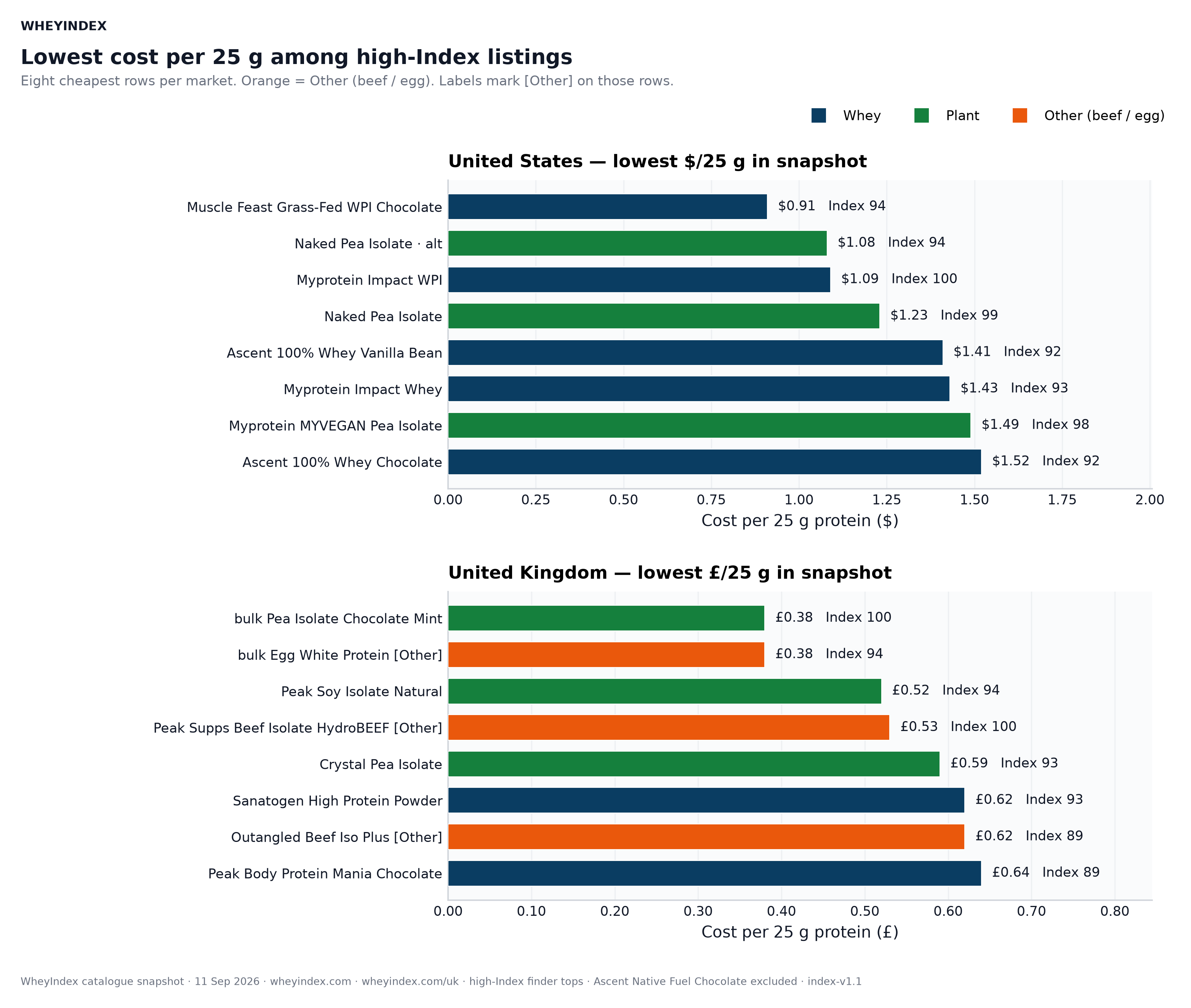
Prices move daily with Amazon listings. Figures below are recorded against the live catalogue; refresh before you cite a SKU.
| Product (as listed) | Index /100 | $/25g |
|---|---|---|
| Muscle Feast Grass-Fed Whey Protein Isolate, chocolate | 94 Excellent | $0.91 |
| Myprotein Impact Whey Protein Isolate, unflavored | 100 Excellent | $1.09 |
| Naked Pea Protein Isolate, unflavored | 99 Excellent | $1.23 |
| Isopure Zero Carb Whey Isolate, unflavored | 93 Excellent | $2.13 |
| Optimum Nutrition Gold Standard 100% Whey, Double Rich Chocolate | 93 Excellent | $2.68 |
| NAKED Whey, strawberry | 77 Good | $1.87 |
Sources: https://www.wheyindex.com/ · https://www.wheyindex.com/compare
Reading the rows:
- Low $/25g can sit with an Excellent Index (Muscle Feast ~$0.91 / 94; Myprotein Impact Isolate ~$1.09 / 100). Cheap per gram of protein does not automatically mean a dirty formula.
- Higher $/25g can still clear Excellent (ON Gold Standard Double Rich Chocolate ~$2.68 / 93; Isopure Zero Carb ~$2.13 / 93) when formulation and sugar per 25g matter.
- Unscored still appears elsewhere in the catalogue when formulation evidence (or another required component) is incomplete. Unscored means not enough information. We do not invent a zero or a perfect score to fill the hole.
$/25g measures protein cost. The Index (formulation, sugar per 25g, and value) measures the blended quality comparison. Read both. Full weights: How the Index works.
Compare trio
Default three-up on Compare:
| ON Gold Standard Double Rich Chocolate | Isopure Zero Carb Whey Isolate (unflavored) | NAKED Whey (strawberry) | |
|---|---|---|---|
| Index | 93 Excellent | 93 Excellent | 77 Good |
| $/25g | $2.68 | $2.13 | $1.87 |
| Protein/serving | 24g | 25g | 25g |
| Formulation /100 | 100 | 100 | 100 |
| Sugar /25g | 1.0g | 0.0g | 7.0g |
On $/25g alone, Naked leads this trio; ON is the expensive scoop here. On Index, Isopure and ON clear Excellent; Naked lands Good, with sugar at 7.0g per 25g protein pulling the blended score down. Protein cost and formulation-plus-sugar answer different questions.
$/25g inside the Index
Value is only a small slice of Index. We benchmark cost per 25g inside the same sales market (US listings in USD today). Lower cost scores higher on that component; ties share a score. Value moves when prices or catalogue coverage change. It never outweighs formulation plus sugar. Details: How the Index works.
- Finder sort Lowest cost per 25g: economics only.
- Finder sort Highest Index: formulation, sugar thresholds per 25g, and value together.
- Recommended preference ranking is separate from the Index score.
A roundup that shows only tub price, or only a proprietary score with no $/25g, leaves the value claim unauditable. Methodology publishes the formula; product cards publish the live numbers.
Shopping checklist
- Treat best-seller badges and tub sticker as secondary.
- Read $/25g on WheyIndex, or compute it from the label.
- Read Index /100 when scored. Treat Unscored as incomplete evidence, not a hidden fail.
- Check sugar per 25g and formulation if those preferences matter (preferences, not safety verdicts).
- Open Compare for two or three finalists and share the link instead of a marketing screenshot.
Citations: product URLs + https://www.wheyindex.com/how-the-index-works
Scope
Scores are not for sale. This is a comparison model. It is not a lab assay and not PDCAAS/DIAAS. It is not medical advice. Cheapest $/25g is not always the right scoop; sometimes a higher cost per 25g pairs with a stronger formulation and sugar profile.
Next step
Look up the powders you already buy, or the two you are deciding between. Sort by cost per 25g, then by Index.
https://www.wheyindex.com/ https://www.wheyindex.com/compare https://www.wheyindex.com/how-the-index-works
Affiliate links may earn a commission. They do not change Index scores or $/25g math.